Why ComplianceAide Requires No Traditional Integration?
Executive Summary
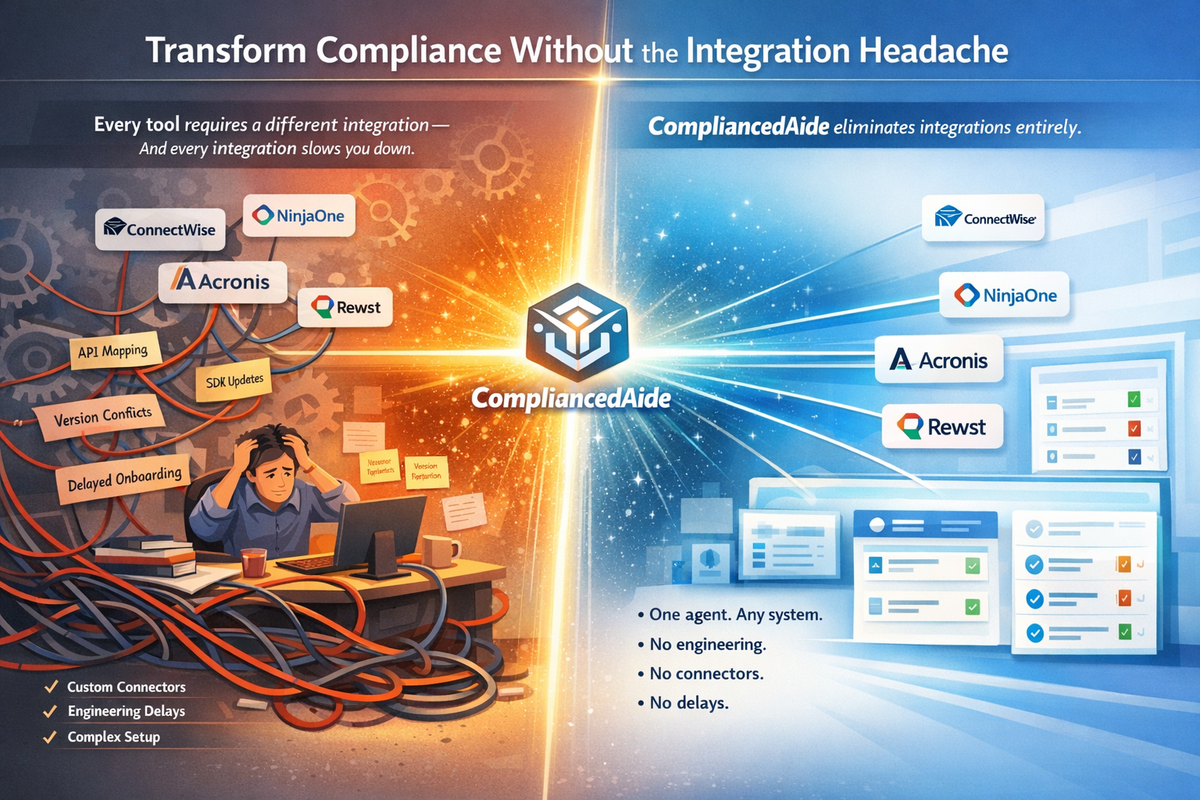
A vendor recently expressed concern that integrating ComplianceAide into their platform would require significant engineering effort and long timelines. That assumption was based on the legacy model of integrations, where two companies must jointly build, test, and maintain connectors.
ComplianceAide does not operate on that model.
Our autonomous agent integrates with Vendors (and any MSP platform) without requiring engineering work from either side. It does this by dynamically learning the target system, using the customer’s existing API keys or portal credentials, and generating its own integration logic on demand.
This document explains:
- How ComplianceAide integrates with Vendors today
- Why our approach is dramatically faster than traditional integrations
- Why this eliminates the historical objections around effort, timelines, and maintenance
1. Traditional Integrations: Slow, Expensive, and Rigid
In the legacy MSP ecosystem, integrations follow a predictable pattern:
Traditional Integration Workflow
- Two engineering teams scope the integration
- APIs are reviewed, mapped, and version‑locked
- SDKs or connectors are built
- QA cycles begin
- Both sides maintain the integration indefinitely
This process typically takes 3–12 months, requires ongoing maintenance, and breaks whenever the vendor updates their platform.
This is the model that the Vendor assumed ComplianceAide required.
2. ComplianceAide’s Model: Zero‑Integration Architecture
ComplianceAide does not rely on prebuilt connectors, SDKs, or vendor‑side engineering.
Instead, our autonomous agent:
- Receives the customer’s existing Vendor API keys
- Attempts to access the system like a human technician
- If portal access fails, it researches the Vendor API documentation
- It then writes its own API client autonomously
- It extracts the required data and normalizes it for compliance workflows
This is not hypothetical it already works.
From our Proof of Concept
We copied and pasted the Vendor keys that a client gave us. We asked for 10 customers an hour the agent replied with an Excel spreadsheet of 10 customers that the vendors client has.
No engineering.
No connector.
No prior knowledge of Vendor.
No involvement from Vendor’s team.
The agent built the integration itself.
3. Real‑World Example: Vendor Integration in Under One Hour
During testing:
- The agent was provisioned from a blank state
- It had zero prior knowledge of Vendor
- It received only the API keys
- It attempted portal access
- It pivoted to API access
- It researched the API docs
- It wrote its own integration code
- It delivered customer data in an Excel file
This is the opposite of a traditional integration timeline.
What normally takes months took under 60 minutes.
4. Why This Matters to Vendor and Other MSP Vendors
No engineering effort required from Vendor
We do not need:
- API changes
- SDK support
- Joint development
- QA cycles
- Roadmap alignment
No maintenance burden
Because the agent dynamically adapts:
- If Vendor updates an endpoint, the agent re‑learns it
- If authentication changes, the agent adjusts
- If new data structures appear, the agent re‑parses them
This eliminates the long‑term maintenance cost that vendors fear.
No risk to Vendor’s platform
We use the same API keys Vendor already provides to every MSP.
We do not require elevated permissions or backend access.
5. Speed Comparison: ComplianceAide vs. Traditional Integrations
|
Step |
Traditional Integration |
ComplianceAide Autonomous Agent |
|
Scoping |
2–6 weeks |
None |
|
API
mapping |
4–12
weeks |
Agent
reads docs automatically |
|
Development |
8–24
weeks |
Agent
writes its own API client |
|
QA |
4–12
weeks |
Agent
tests its own calls |
|
Maintenance |
Ongoing |
Self‑healing |
|
Total
Time |
6–12
months |
< 1
hour |
This is not an incremental improvement it is a complete inversion of the integration model.
6. Why Vendor’s Original Objection No Longer Applies
Vendor assumed ComplianceAide required:
- A formal integration
- Engineering resources
- A multi‑month roadmap
- Ongoing maintenance
In reality:
- We require none of these
- The agent handles integration autonomously
- The customer provides the same API keys they already use for every other tool
- ComplianceAide becomes a zero‑effort, zero‑risk partner
This reframes ComplianceAide from “integration burden” to “integration‑free automation layer.”
7. Strategic Implications for Vendor and the MSP Ecosystem
For Vendor
ComplianceAide becomes a value‑add with no engineering cost.
For MSPs
They onboard instantly no waiting for connectors.
We scale across every MSP platform without ever building integrations.
To see the platform try our free 7 day trial visit our website at www.thecomplianceaide.com and hit the trial button.