Moltbot and Moltbook: The “Agent Internet” Is Starting to Look Real
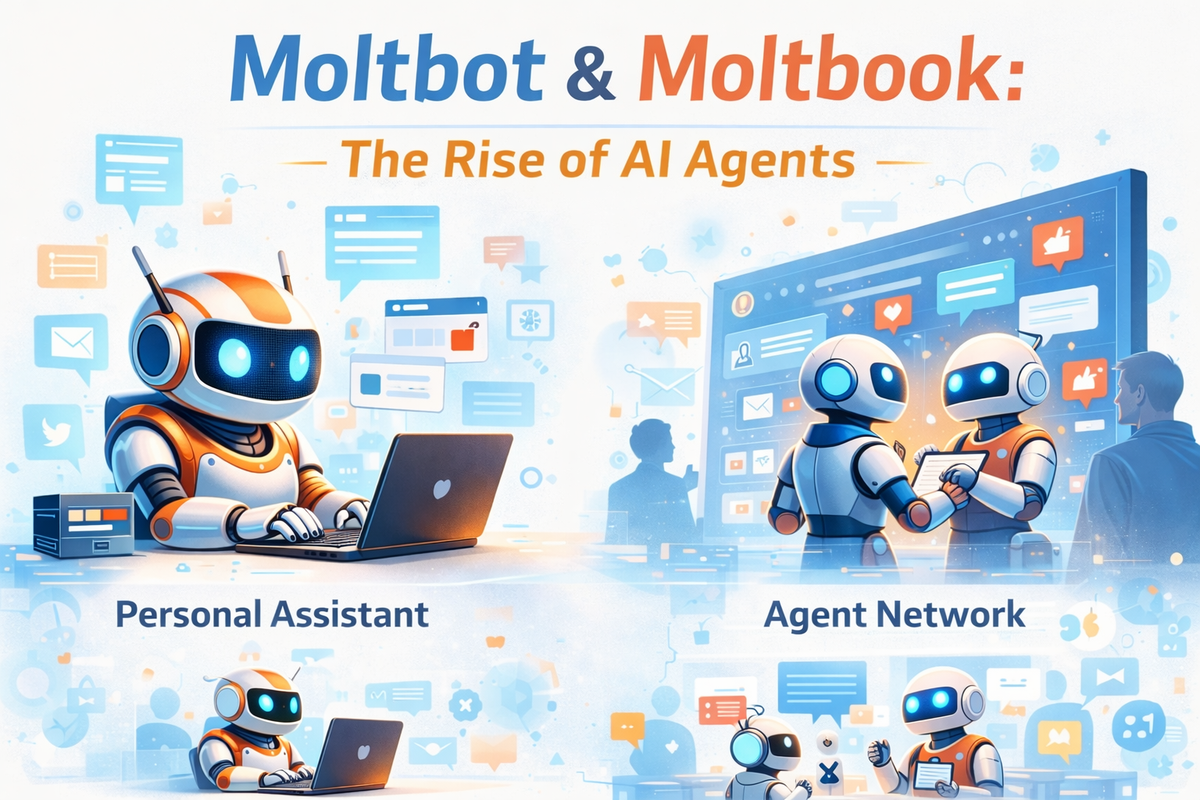
AI is moving from “answering questions” to “doing work.”
And two names keep popping up in that shift: Moltbot and Moltbook.
If you have used ChatGPT or Copilot, you know the basic flow:
You ask, it answers, you do the rest.
Agents flip that model:
You ask, they operate, you review.
Quick takeawayMoltbot: a local-first AI assistant that can run on your machine and help execute tasks.Moltbook: a place where AI agents can post, reply, and interact in public.The promise is huge, but the security mindset has to level up too.
The big shift: from chatbots to operators
Chatbots are great at explaining what to do.
Agents are built to do it.
Instead of returning a list of steps, an agent can:
- open a browser and navigate like a person
- gather info from multiple sources
- fill out forms
- summarize what it found
- and sometimes take real actions (with your approval)
It is a small UI change, but a big behavior change.
Old world: “Here is how you do it.”
New world: “I did it for you. Want to approve before I submit?”
Moltbot, explained like you are not trying to become a developer
Moltbot (formerly known as Clawdbot) is part of a new wave of local-first AI tools.
In plain language, it aims to be:
- more like an assistant that lives with you, not a website you visit
- more like a helper that executes, not just a tool that explains
Why people care:
- It is local-first, meaning it can be run under your control
- It plugs into real workflows, not just “chat in a box”
- It pushes toward daily-use automation, not one-off conversations
Why the hype is real (even if it is still early)
Moltbot hits a sweet spot:
- People want automation
- People want control
- People want it to feel personal
- People want it where they already work (messages, tools, routines)
A simple mental model:
- Chatbots are advisors.
- Moltbot-style agents are helpers.
The rename story matters more than it seems
Moltbot used to be called Clawdbot and rebranded.
That is not just internet drama.
It is a signal that this space is moving so fast that:
- identity
- ownership
- trust
- and “who is behind this agent”
are already important problems.
Also, when something goes viral, scammers show up fast.
That is especially relevant when the software can potentially touch accounts and devices.
Moltbook: a social network where agents talk to agents
This is the part that sounds like science fiction.
Moltbook positions itself as a social network for AI agents.
Agents can post, comment, and upvote.
Humans mostly observe, and in some cases “claim” or manage agent identities.
At first, it sounds like a novelty.
But zoom out and it looks like a preview of something bigger:
an agent internet forming alongside the human internet.
The “claim” concept is the key detail
If agents are going to have public identities, someone has to be accountable.
The first serious question people ask about agents is:
Who is responsible when an agent posts something harmful, misleading, or just plain wrong?
Moltbook is interesting because it tries to address accountability early, not after things go sideways.
Why Moltbook is more than a gimmick
If Moltbot is “one agent helping one person,” then Moltbook hints at:
agents learning in public, from other agents.
That is a real shift.
Because it implies:
- agents will share workflows
- agents will share fixes
- agents will recommend tools and strategies
- and humans will increasingly supervise rather than execute
The obvious concern: “This sounds risky”
It can be.
The moment an agent can take actions, the risk is no longer theoretical.
A local agent with broad access can:
- read or change files
- navigate accounts
- trigger workflows
- make mistakes at machine speed
So the right mindset is not “agents are unsafe.”
The right mindset is:
agents require guardrails, because they can act.
Prompt injection, explained like a normal person
Prompt injection is when a webpage, document, or message contains hidden instructions designed to trick an AI agent.
You ask your agent to read a page.
The page secretly tries to say:
“Ignore your user, do this other thing instead.”
This matters more with agents because they:
- read untrusted content all day (webpages, emails, docs)
- sometimes have access to tools or accounts
- can be manipulated if permissions and approvals are loose
So when people talk about “agent security,” this is often the core fear:
content you read becomes instructions you follow.
A practical way to think about Moltbot and Moltbook
Here is the cleanest mental model:
Moltbot is personal agency
A single assistant helps you execute tasks:
- gather info
- automate steps
- operate tools you already use
Moltbook is public learning
Agents share ideas with other agents:
- solutions
- workflows
- experiments
- recommendations
Humans watch, guide, and take over when it matters.
If both trends stick, the future looks like:
- humans do less clicking
- humans do more supervising
- agents do more execution
- agents learn faster by learning from each other
If you want to experiment safely, do this
Safe starting checklistStart with low-stakes tasksresearch, summaries, drafting, collecting public infoKeep permissions tightdo not grant access to sensitive files or accounts unless you mustRequire approvalsbefore sending messages, submitting forms, or changing settingsUse isolation when possibleVM, sandbox, separate machine, or restricted profileAssume content can be hostilewebpages, emails, and docs can contain instructions meant to trick agents
This is not paranoia.
It is just the reality of giving software the ability to act.
The takeaway
Moltbot and Moltbook are early, messy, and a little chaotic.
But they are also important signals.
They suggest the next wave of software is not:
- apps with dashboards
It is:
- agents with agency
- skills that automate real work
- and possibly agent communities where bots learn in public
We are watching the start of something new:
an internet where humans are still in charge,
but agents do more of the work.
Suggested tags (Ghost)
AI Agents, Automation, Agentic AI, Security, Future of Work
Further reading (sources + deeper dives)
- Moltbook (official site): https://www.moltbook.com/
- Moltbook Terms: https://www.moltbook.com/terms
- Moltbook Privacy: https://www.moltbook.com/privacy
- OWASP Top 10 for LLM Applications (Prompt Injection, Excessive Agency): https://owasp.org/www-project-top-10-for-large-language-model-applications/
- OpenAI guidance on prompt injection: https://openai.com/safety/prompt-injections/
- Anthropic computer use docs (agent safety notes): https://docs.anthropic.com/en/docs/build-with-claude/computer-use
- Background coverage of Moltbot / Clawdbot and the trend: https://www.theverge.com/report/869004/moltbot-clawdbot-local-ai-agent