If I Gave Your MSP $1,000,000 for AI, I Would Spend Most of It on People
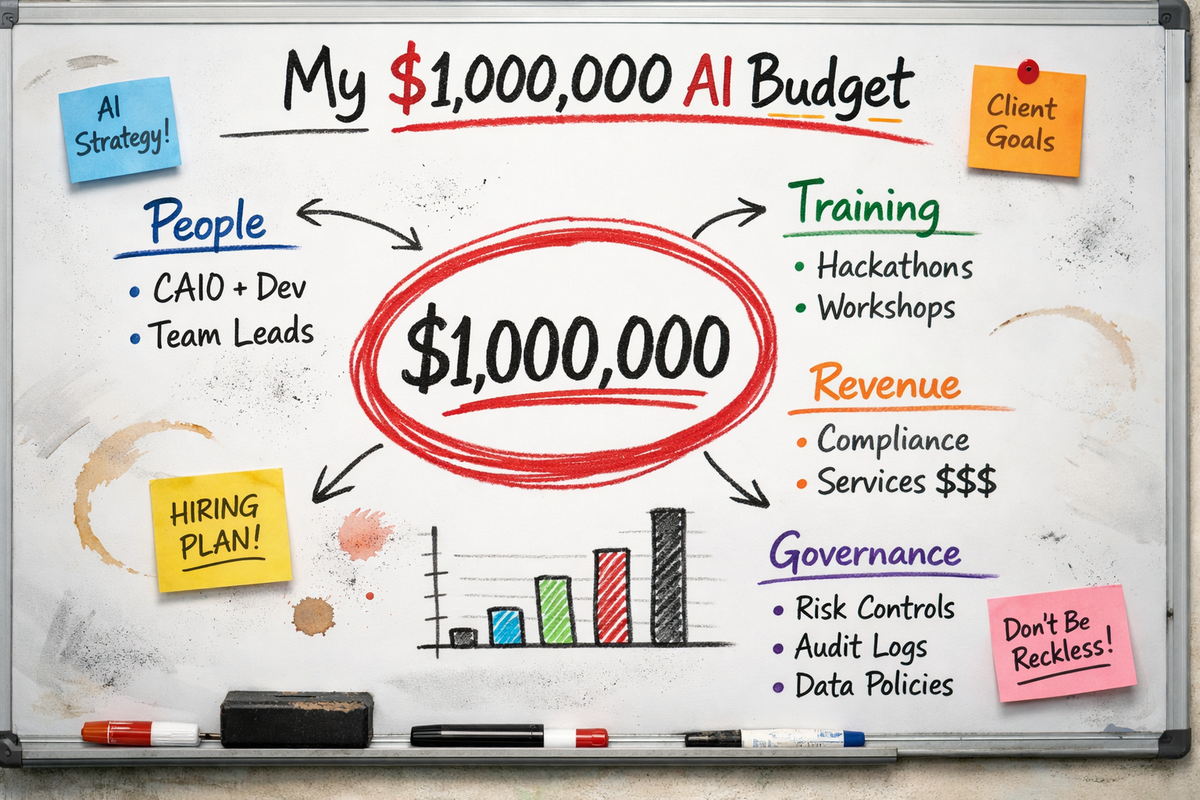
AI is collapsing the cost of building software.
A capable AI builder can now spin up what used to be a $2M internal app for the cost of a few subscriptions and a weekend. MSPs are about to get flooded with tools, agents, copilots, wrappers, dashboards, and vendor pitches that all sound like the future.
That changes what a smart AI budget looks like. The goal is not to pick one magical platform. The goal is to build an AI-capable workforce that can explore modern AI tools safely, standardize outcomes, and productize results into revenue.
Tools will multiply. The winning MSPs will be the ones who can evaluate them quickly, implement them safely, and operationalize them without breaking trust.
Thesis: Your moat is not tools. Your moat is trained people, repeatable delivery, and governance.
The strategy
AI-first is an operating model, not a procurement event.
- Teams try AI before they try the old way
- You standardize workflows, templates, and review steps
- You fund training and adoption, not just licenses
- You govern AI like any other operational risk
- You productize outcomes into services clients pay for
Buying licenses without changing workflows is like buying an RMM without onboarding and process. The ROI will disappoint.
The MSP reality: you are multi-tenant and trust is the product
MSPs are not like internal IT teams. Your staff touches multiple clients. Your outputs become deliverables. A minor AI mistake can turn into a major trust event.
So a real AI plan has to include:
- Approved AI platforms employees can explore
- Clear rules for client data handling
- Human review and quality gates
- Training that makes results consistent, not random
The $1,000,000 budget
Assumptions: mid-sized MSP (50 to 150 employees), internal efficiency plus a revenue engine, salary figures are base pay estimates. The point is not perfect accounting. The point is a budget that forces adoption and produces measurable outcomes.
Leadership and builders
Chief AI Officer - $170,000
Accountable for AI-first adoption, governance, ROI, and vendor standards.
For a serious MSP, this role should understand NIST AI RMF and ISO/IEC 42001.
Agentic Developer - $125,000
The CAIO’s right hand. Integrates AI into PSA/RMM/docs, builds automations and agentic workflows, maintains reliability.
Tools they should live in:
Codex, RooCode, Claude Code, plus integration patterns like MCP and APIs.
Agentic cybersecurity compliance
This is the revenue engine. Compliance is evidence-heavy, repeatable, and perfect for agentic workflows.
Cost model: $1,800 per client in tooling costs.
MSP income model: $7,000 to $10,000 per client.
2026 target: 100 clients.
Math: $180K expense for $700K to $1M potential income. The goal is to use services revenue to keep funding the AI program.
Employee AI subscriptions (explore approved tools)
The goal is not to force one platform. The goal is to let employees explore a short list of approved AI tools while you standardize workflows, review, and data rules.
General staff access - $52,800
Allow up to 110 employees to purchase up to (2) $20/month subscriptions to their preferred AI tool.
Examples: ChatGPT, Claude, Gemini
Power user access - $144,000
Allow up to 30 employees to purchase up to (2) $200/month professional subscriptions.
Examples: ChatGPT Pro, Claude Code Pro, Gemini Pro, Anthropic offerings
Training and internal acceleration
$8,000/month training budget to drive real adoption, not theory.
- Hackathons focusing on internal process gains
- Lunch and learns on: AI tokens, agentic coding, multi-modality, prompt engineering
- Hands-on sessions using: ChatGPT, Claude, Gemini, Codex, RooCode, Claude Code
Role upgrades and transitions
AI-first changes job roles. If you do not budget for that, you get resistance and shadow AI usage.
Role re-classifications - $120,000
Raises for employees who fully dive into AI-first responsibilities.
Job elimination reserve - $100,000
Reserved to handle job elimination or transition support responsibly.
Governance and guardrails
- Approved tool list (ChatGPT, Claude, Gemini, plus Pro/Code tiers)
- Client data handling rules and tenant boundaries
- Human review requirements for client-facing deliverables
- Basic evaluation, incident response updates, and auditability expectations
Budget recap
| Category | Budget |
|---|---|
| Leadership and builders | $295,000 |
| Agentic cybersecurity compliance | $180,000 |
| Employee AI subscriptions | $196,800 |
| Training and internal acceleration | $96,000 |
| Role upgrades and transitions | $220,000 |
| Governance and guardrails | $12,200 |
| Total | $1,000,000 |
What success looks like (MSP KPIs, not vibes)
Adoption:
- Weekly active users across approved AI platforms (ChatGPT, Claude, Gemini, plus Pro/Code tiers where appropriate)
- Standard workflows adopted per team (not just personal prompts)
Efficiency:
- Ticket resolution cycle time reduction
- Faster documentation updates and fewer stale KB articles
- Faster proposal and QBR drafting with required human review
Quality:
- Reduced rework on deliverables
- Fewer tribal knowledge escalations
- Lower error rate in client-facing documentation
Revenue and retention:
- Compliance offering conversions and expansion (pilot to repeatable delivery)
- Attach rate and churn impact
Risk:
- Fewer policy violations because approved tools and rules are easy to follow
- Clear evidence of review, governance, and auditability
The 90-day rollout so this does not stay theoretical
Days 1 to 30:
- Approve an exploration set of AI platforms (ChatGPT, Claude, Gemini) and define rules for client data and secrets
- Identify 10 power users and give them Pro/Code tooling (ChatGPT Pro, Claude Code Pro, Gemini Pro, plus Codex/RooCode where it fits)
- Pick two internal workflows to improve and define what “done” means (quality gates included)
Days 31 to 60:
- Run the first hackathon focused on measurable internal wins
- Ship the first two AI-assisted workflows with review steps and logging expectations
- Start packaging the compliance offer for a pilot cohort
Days 61 to 90:
- Expand to five workflows and standardize playbooks and prompts
- Launch the first pilot compliance clients and measure delivery time, quality, and profitability
- Report outcomes monthly with a simple KPI view leadership can trust
Final thought
AI tool options are about to explode. That is exactly why the smartest AI budget is not tool-heavy.
Your moat is training and operational capability: a workforce that knows how to use AI responsibly, a delivery model that produces consistent outcomes, and governance that protects client trust. If you want a 2026 AI plan that survives reality, start there.